The Sahara Desert is often imagined as a lifeless expanse of sand, yet across southern Morocco it supports a specialized and surprisingly consistent community of birds. While species diversity is lower than in wetlands or mountain regions, the birds of the Sahara Desert are highly adapted to extreme heat, scarce water, and open landscapes. For birdwatchers and naturalists, understanding which species genuinely occur rather than relying on inflated lists is key to appreciating Sahara Desert birds in Morocco.
This article focuses on realistic, regularly observed birds in the Moroccan Sahara, particularly around dunes, rocky plains, wadis, and oases.
Birds in the Sahara Desert: Habitats and Survival Conditions
The Moroccan Sahara is not a uniform environment. Instead, it is a mosaic of distinct habitats, each supporting different bird species. These landscapes shape how birds live, feed, and survive under harsh desert conditions.
Key Desert Habitats
- Sand dunes (ergs) such as Erg Chebbi near Merzouga, dominated by shifting sands and sparse vegetation
- Rocky plains and regs, where gravel and stone replace sand
- Dry wadis, which may carry water briefly after rain
- Oases and palm groves, offering shade, food, and permanent or seasonal water
Environmental Challenges
Birds in the Sahara Desert contend with:
- Daytime temperatures exceeding 45°C
- Limited food resources
- Minimal surface water
- High exposure to predators
Adaptations of Sahara Desert Birds
Saharan bird species display several survival strategies:
- Activity concentrated in early morning and late afternoon
- Cryptic plumage for camouflage against sand and stone
- Ground nesting to avoid wind exposure
- Nocturnal or crepuscular behavior in some species
- Efficient water conservation through diet and physiology
These adaptations allow desert-adapted birds to persist in conditions where few vertebrates can survive year-round.
Common Sahara Desert Birds You Can Really See in Morocco
Rather than focusing on rare vagrants or irregular records, the following species represent birds that are genuinely encountered in the Moroccan Sahara, particularly around Merzouga, Erfoud, Ouzina, and the Tafilalt region.
Ground-Dwelling and Open Desert Species
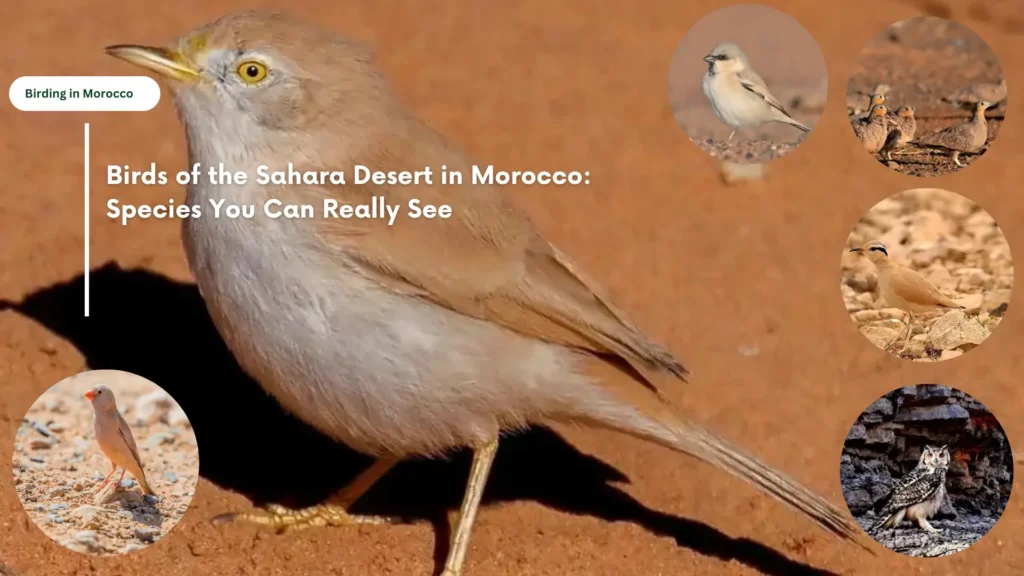
- Desert Sparrow – A true Sahara specialist, typically found around desert settlements, wells, and palm groves
- Bar-tailed Lark – One of the most characteristic Sahara Desert birds, often seen running across open gravel plains
- Thick-billed Lark – Prefers stony desert habitats with sparse vegetation
- Hoopoe Lark – Notable for its upright posture and display flights over open desert
- Cream-colored Courser – A fast-moving species of flat, open terrain, especially regs
Finches and Corvids
- Trumpeter Finch – Common around dunes and rocky areas, often in small flocks
- Brown-necked Raven – A widespread and adaptable species, frequently seen near human habitation
Nocturnal and Crepuscular Species
- Egyptian Nightjar – Typically roosts on open ground during the day, becoming active at dusk
Desert Birds Associated with Water Sources
- Spotted Sandgrouse – Regularly seen flying to water at dawn
- Crowned Sandgrouse – Often encountered in arid plains near oases
These species form the core of Saharan avifauna in Morocco and are present throughout much of the year.
Where to See Birds of the Sahara Desert in Morocco
Southern Morocco offers several well-defined regions where Sahara Desert birds are consistently observed.
Key Areas
- Merzouga Desert and Erg Chebbi – Dunes, regs, and seasonal water attract desert specialists
- Erfoud and Rissani – Transitional zones between oasis agriculture and open desert
- Ouzina area – Remote desert plains with minimal disturbance
- Tafilalt Oasis – A major refuge for birds in an otherwise arid region
- Drâa Valley – Important for both resident desert birds and seasonal migrants
Best Observation Conditions
- Early morning and late afternoon provide the highest activity levels
- Cooler months improve daytime visibility
- Oases and wadis concentrate birdlife during dry periods
Birds of the Sahara Desert in Morocco are rarely encountered by chance; understanding habitat and timing is essential.
Conclusion
Sahara Desert birds are not numerous, but they are among the most specialized and resilient avian species in North Africa. In Morocco, the combination of dunes, rocky plains, and oases supports a consistent set of birds that can be observed with patience and realistic expectations. By focusing on species you can really see, the Sahara reveals itself not as an empty wilderness, but as a finely balanced ecosystem shaped by extreme conditions and remarkable adaptations.