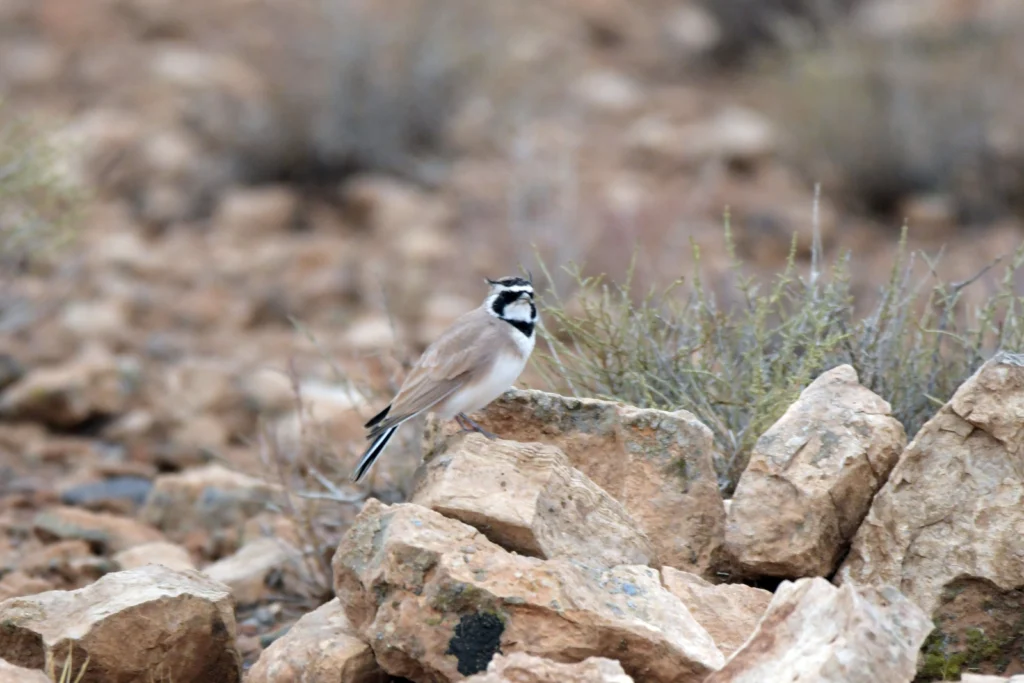
Temminck’s Lark (Eremophila bilopha) is one of the most distinctive desert larks found in Morocco. With its striking facial pattern, compact shape and preference for dry, open landscapes, it is a highly sought-after species for birdwatchers exploring the country’s arid regions.
For birders looking specifically for Temminck’s Lark in Morocco, one of the most important areas is the Boumalne Dades region, particularly the famous Tagdilt Track. This open, stony steppe is well known for its exceptional concentration of desert and steppe birds. Temminck’s Lark can be encountered here alongside Thick-billed Lark, Bar-tailed Lark, Desert Lark, Cream-coloured Courser, Red-rumped Wheatear, Maghreb Wheatear and other species of Morocco’s arid landscapes.
Tagdilt Track is located on the eastern outskirts of Boumalne Dades and consists largely of flat, dry and open steppe habitat. It is one of the most productive birding sites in southern Morocco for finding a variety of larks and desert specialists.
If Temminck’s Lark is on your Morocco birdwatching list, understanding how to identify it, where it lives and how to search for it can make a major difference.
Temminck’s Lark Identification, Appearance and Behaviour
What Does Temminck’s Lark Look Like?
Temminck’s Lark is a small-to-medium-sized lark with a distinctive appearance that makes it easier to recognize once you become familiar with its features.
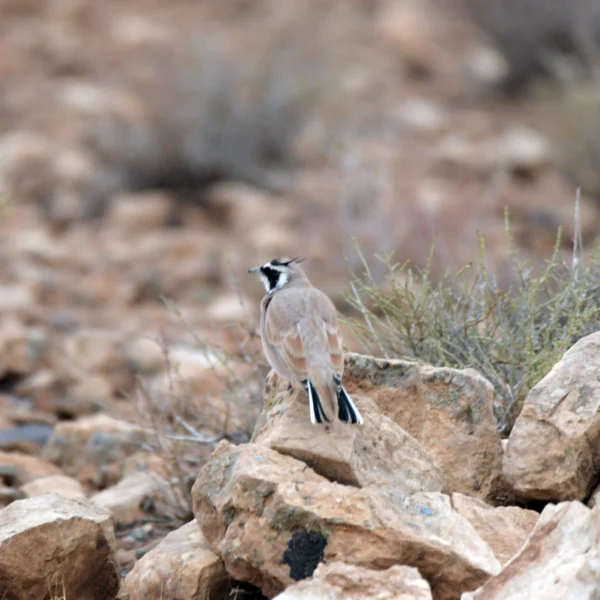
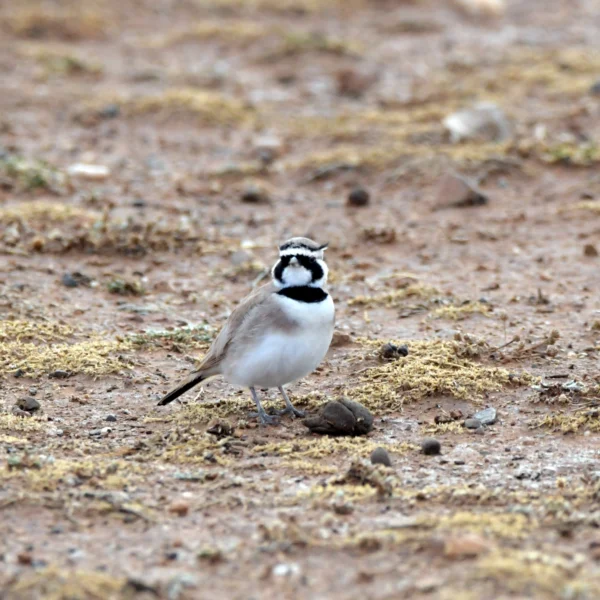
The species has a relatively compact body, short-looking tail and noticeable facial markings. Its plumage is predominantly sandy, buff and brown, helping it blend remarkably well into the dry ground where it feeds.
One of the most useful identification features is its contrasting facial pattern. The pale face is marked with darker areas around the eye and cheek, giving the bird a distinctive expression. The combination of its facial markings, sandy plumage and desert habitat makes Temminck’s Lark quite recognizable with good views.
However, the species can be surprisingly difficult to spot at first because its plumage provides excellent camouflage against the gravel and dusty soil of the Moroccan steppe.
How to Identify Temminck’s Lark in the Field
When searching for Temminck’s Lark, focus on several features rather than relying on colour alone:
- Sandy-buff overall plumage
- Strongly marked face
- Darker markings around the eye and cheek
- Compact body shape
- Short-looking tail
- Preference for walking and feeding on open ground
- Habit of blending into gravelly and stony terrain
At Tagdilt Track, scanning the ground carefully is often more productive than simply looking into the sky. Temminck’s Larks may walk through the open terrain while feeding, and their cryptic plumage can make them surprisingly easy to overlook.
During a 2025 Morocco birding tour, observers recorded excellent views of adult Temminck’s Larks feeding juveniles on the Boumalne plains, demonstrating how productive this area can be.
Temminck’s Lark Call and Behaviour
Like many larks, Temminck’s Lark is primarily a ground-feeding bird and spends much of its time walking across open terrain.
Its behaviour can vary according to season and breeding activity. Birds may occur singly, in pairs or in small groups, while breeding areas can hold several individuals.
One of the best strategies for finding the species is therefore to drive slowly through suitable habitat, stop regularly and scan the ground with binoculars or a telescope.
The wide, open landscapes around Boumalne Dades are particularly suitable for this style of birding because there are few visual obstacles.
What Does Temminck’s Lark Eat?
Temminck’s Lark feeds mainly on food found on or close to the ground. Its diet includes seeds and small invertebrates, with feeding behaviour changing according to season and availability.
This ground-feeding lifestyle is closely linked to its preferred habitat. Open steppe and sparsely vegetated plains provide both feeding opportunities and relatively unobstructed ground for walking and searching for food.
Temminck’s Lark vs Similar Lark Species
Morocco is home to a remarkable variety of larks, and several species can occur in the same general landscapes.
At Tagdilt Track, birdwatchers may encounter Temminck’s Lark alongside Thick-billed Lark, Bar-tailed Lark, Desert Lark, Greater Short-toed Lark and Thekla’s Lark. Birding reports from the area repeatedly highlight this exceptional lark diversity.
The key is to look at the entire bird: facial pattern, structure, plumage, behaviour and habitat. Rather than identifying a bird from colour alone, compare its shape and markings with the other larks present in the same area.
Temminck’s Lark Habitat, Range and Distribution in Morocco
Where Does Temminck’s Lark Live?
Temminck’s Lark is strongly associated with dry, open environments. It favours arid and semi-arid landscapes where vegetation is sparse and large areas of bare or stony ground are available.
Typical habitat can include:
- Dry steppe
- Gravel plains
- Stony desert
- Semi-desert
- Rocky open terrain
- Sparsely vegetated plains
- Arid plateaus
These landscapes are very different from the sandy dune habitats many visitors associate with the Sahara. For birdwatchers, this distinction is important: searching for Temminck’s Lark means concentrating on suitable open steppe and stony desert habitat.
Temminck’s Lark Habitat in Morocco
In Morocco, the Boumalne Dades region is particularly important for birdwatchers looking for Temminck’s Lark.
The famous Tagdilt Track lies on the eastern side of Boumalne Dades in an open steppe landscape. Birdingplaces describes the site as a flat, dry and open plain/steppe environment, while birding tour reports repeatedly record Temminck’s Lark there.
The landscape around Boumalne Dades is especially attractive for birders because several desert and steppe specialists can occur in the same area.
This makes Tagdilt Track much more than a single-species location. A morning searching for Temminck’s Lark can also produce a selection of other highly desirable Moroccan birds.
Temminck’s Lark on Tagdilt Track
Tagdilt Track near Boumalne Dades is one of the best-known places to search for Temminck’s Lark in Morocco.
Historical and recent birding reports both confirm the species from the area. A BirdQuest Morocco report recorded Temminck’s Larks as fairly common on the Tagdilt Track, while another report described large groups of Temminck’s Larks on the sandy plateau around the track.
More recent observations continue to support the importance of the Boumalne area. In 2025, birders recorded several adult Temminck’s Larks feeding juveniles on the Boumalne plains before continuing to the Tagdilt Track, where they also found Red-rumped Wheatear and Cream-coloured Courser.
The combination of open terrain and a rich desert bird community makes this one of the most rewarding places for Morocco birdwatching.
Other Desert Birds of Morocco
One of the biggest attractions of birdwatching around Tagdilt Track is the variety of species that can be encountered during the same outing.
Depending on season and conditions, birdwatchers may look for:
- Temminck’s Lark
- Thick-billed Lark
- Bar-tailed Lark
- Desert Lark
- Greater Short-toed Lark
- Thekla’s Lark
- Cream-coloured Courser
- Red-rumped Wheatear
- Maghreb Wheatear
- Desert Wheatear
- Trumpeter Finch
- Black-bellied Sandgrouse
- Pin-tailed Sandgrouse
Birding Ecotours specifically lists Temminck’s Lark, Bar-tailed Lark, Thekla’s Lark, Greater Short-toed Lark and Thick-billed Lark among the larks to look for at Tagdilt Track, together with Cream-coloured Courser and several desert wheatears.
This combination makes the Boumalne Dades area one of the most exciting destinations for birders interested in Morocco’s desert birds.
Where to See Temminck’s Lark in Morocco
Best Place to See Temminck’s Lark: Tagdilt Track
If your main goal is to see Temminck’s Lark in Morocco, Tagdilt Track near Boumalne Dades should be high on your birding itinerary.
The track is situated on the eastern outskirts of Boumalne Dades and passes through open, dry steppe habitat. The terrain is generally flat and exposed, making it possible to scan large areas for birds on the ground.
The site has a long-established reputation among birdwatchers. Multiple Morocco birding reports have recorded Temminck’s Lark here, sometimes with several individuals or groups of birds.
For anyone interested in Morocco birds, Tagdilt Track is therefore an excellent place to combine Temminck’s Lark with a broader selection of steppe and desert species.
When Is the Best Time to See Temminck’s Lark?
The best time to search for Temminck’s Lark depends on your priorities, but spring can be particularly rewarding because bird activity increases and breeding behaviour becomes easier to observe.
Tagdilt Track is generally considered productive during spring, autumn and winter, with spring migration being one of the recommended periods for visiting the site.
Spring can be especially interesting because resident desert species are active while migrating birds may also pass through the region.
For bird photographers, early morning is often preferable. Cooler temperatures and softer light can make it more comfortable to work in the exposed landscape, while birds are generally more active.
Tips for Finding Temminck’s Lark in Morocco
Finding a well-camouflaged desert lark requires patience. These practical tips can improve your chances:
1. Start early.
Early morning is usually the most comfortable and productive period for birding in exposed desert terrain.
2. Scan the ground carefully.
Temminck’s Lark can blend into the gravel and sandy colours of the steppe.
3. Drive slowly.
The open terrain around Tagdilt Track allows birders to cover a large area by vehicle while stopping regularly to scan.
4. Use binoculars and a telescope.
A telescope can be particularly useful for checking distant birds without approaching too closely.
5. Look for mixed desert bird activity.
Finding Thick-billed Lark, wheatears or Cream-coloured Coursers can indicate that you are in productive habitat.
6. Learn the other larks.
Being familiar with Bar-tailed Lark, Desert Lark, Greater Short-toed Lark and Thekla’s Lark will make Temminck’s Lark identification much easier.
Temminck’s Lark and Morocco Birdwatching Tours
A dedicated birdwatching tour around Boumalne Dades and Tagdilt Track gives birders the opportunity to search systematically across the area’s different habitats.
Rather than visiting only one location, a well-planned birding day can combine the open Tagdilt plains with nearby wadis, rocky areas and other habitats around Boumalne Dades.
This increases the chances of finding several of Morocco’s most interesting desert birds during the same day.
For birdwatchers travelling specifically for larks, the Boumalne Dades region is particularly rewarding because Temminck’s Lark occurs alongside several other specialist species. BirdQuest describes the rocky deserts around Boumalne as holding Temminck’s Lark, Thick-billed Lark and Red-rumped Wheatear, while its reports document repeated sightings around Tagdilt Track.
Final Thoughts
Temminck’s Lark is one of the special desert birds to look for when exploring southern Morocco. Its attractive facial markings, sandy plumage and adaptation to harsh open landscapes make it a fascinating species for both birdwatchers and photographers.
For those asking where to see Temminck’s Lark in Morocco, the Boumalne Dades region and Tagdilt Track stand out as key locations. The area combines suitable habitat with an impressive collection of desert and steppe birds, including Thick-billed Lark, Bar-tailed Lark, Desert Lark, Cream-coloured Courser and Red-rumped Wheatear.
A visit to Tagdilt Track is therefore not simply about finding one lark. It is an opportunity to experience one of Morocco’s most remarkable birding landscapes and search for some of the country’s most specialized desert birds.